Securing roof access before winter: self-supporting guardrails and ladder stabilizers


Marie-Claude Plante
The end of summer is the last comfortable time of year to secure your roof. By November, the same surface becomes slippery, snow hides the roof edge and skylights, and every maintenance visit becomes a fall hazard. Safety installations, however, are done in dry conditions on a clean membrane, without the pressure of impending snowfall.
The Occupational Health and Safety Regulations already impose specific obligations on you in this regard. Delta Prevention’s two most popular solutions meet these requirements, and neither requires penetrating your membrane.
Key points
- As soon as a worker is exposed to a fall of more than 3 meters, the employer must provide protection. The first measure required by the regulation is a guardrail, before a harness.
- According to the CNESST: protection must be installed at the edge of the drop, at a maximum distance of 300 mm from the edge.
- Delta Prevention freestanding guardrails are installed without perforating the membrane : recycled rubber bases, 6061-T6 anodized aluminum pipes and posts, meaning no rust stains on the roof.
- The sliding ladder remains the weak point of roof access. The ladder stabilizer immobilizes it, prevents sliding along the parapet, and replaces improvised bungee cords or ropes.
- Doing the work now also means preparing for snow removal : a roof already surrounded by guardrails can be cleared in winter without having to improvise protection in the snow.
What the law already requires of you
The threshold is clearly defined in the Occupational Health and Safety Regulations. Every worker must be protected against falls if exposed to a fall of more than 3 meters, unless they are simply using a means of access or egress. The threshold drops to 1.5 meters when handling a load, and to 1.2 meters when using a vehicle.
The regulation also prioritizes safety measures. First, the work position is modified to eliminate the risk. Next, you install a guardrail or a travel restraint system, then collective protective equipment such as a net, and only then do you move down to a safety harness connected to an anchor system via a fall arrest lanyard. Collective protection takes precedence over personal protective equipment, and installation is required at the edge of any drop or around any area where a worker is at risk of falling.
The CNESST classifies falls from a height of more than 3 metres as zero-tolerance violations. In the event of a violation, work is stopped and those responsible are subject to criminal prosecution. It also serves as a reminder that falls can occur from fragile surfaces incapable of supporting a worker's weight. On industrial or commercial buildings, these surfaces are numerous, and snow makes them invisible.
Load requirements
The regulation also specifies the required resistance. For temporary guardrails, it sets a horizontal point load of 900 N at any point on the top rail and a vertical load of 450 N. The top rail must be located between 1 m and 1.2 m from the floor, with at least one intermediate rail at mid-height. Guardrails incorporated into the building fall under the National Building Code and must comply with its requirements.
Delta Prevention systems are certified by an independent engineering firm. They meet the load requirements specified in Article 4.1.5.14 of the National Building Code as well as OSHA standards, and the compliance report is available upon request.
Freestanding guardrails: permanent collective protection
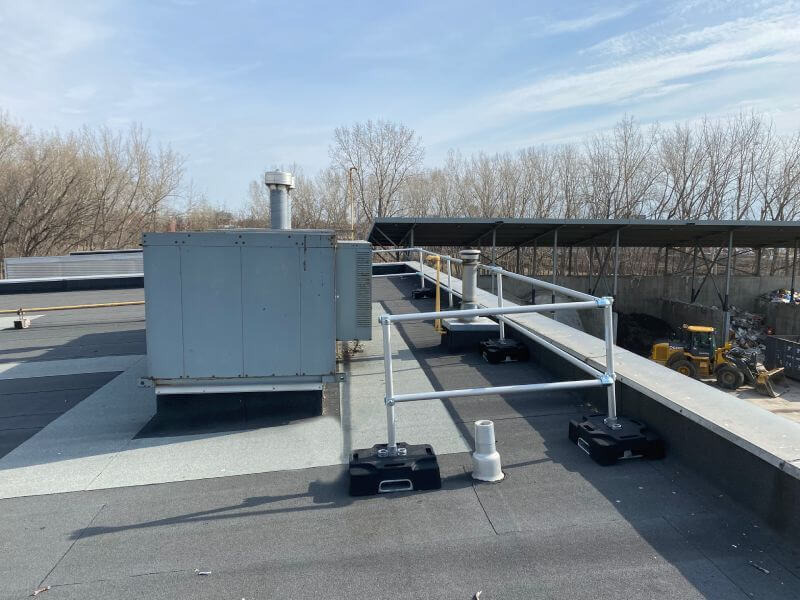
A freestanding guardrail eliminates the risk of falling rather than managing it. Safety is then inherent to the site itself, rather than relying on individual equipment for every person who accesses the roof: maintenance staff, refrigeration technicians, roofers, and subcontractors who are unfamiliar with your building. Delta Prevention freestanding roof guardrail systems are installed without any anchoring—meaning no roof membrane penetration—on roofs with or without a parapet.
Two configurations share the same patented recycled rubber base. The VSS CLASSIC configuration is linear and secures a minimum of 10 feet up to the entire perimeter, without any full-height returns, keeping it discreet in relation to the building's appearance. The VSS COMPACT configuration is designed for restricted spaces between mechanical units and the parapet. A 5-foot return at each end is sufficient, regardless of length, and every 40 feet when there is no parapet. Both can be used together on the same roof.
Materials matter just as much as geometry. The pipes and vertical posts are made of 6061-T6 anodized aluminum, making them ultra-lightweight for installation, free of paint that could flake off, and corrosion-resistant. DELTAMAX bases are placed directly on the roof without the need for a sacrificial membrane, offering high adhesion and a molded handle for easy transport. No cracking, no leaking of filler material, and no rust stains on the membrane. The manufacturer offers a 10-year warranty, and the products are designed and manufactured in Quebec.
The same bases are also used for singular points : skylights, roof hatches, and around HVAC units.
The ladder stabilizer: securing the access point
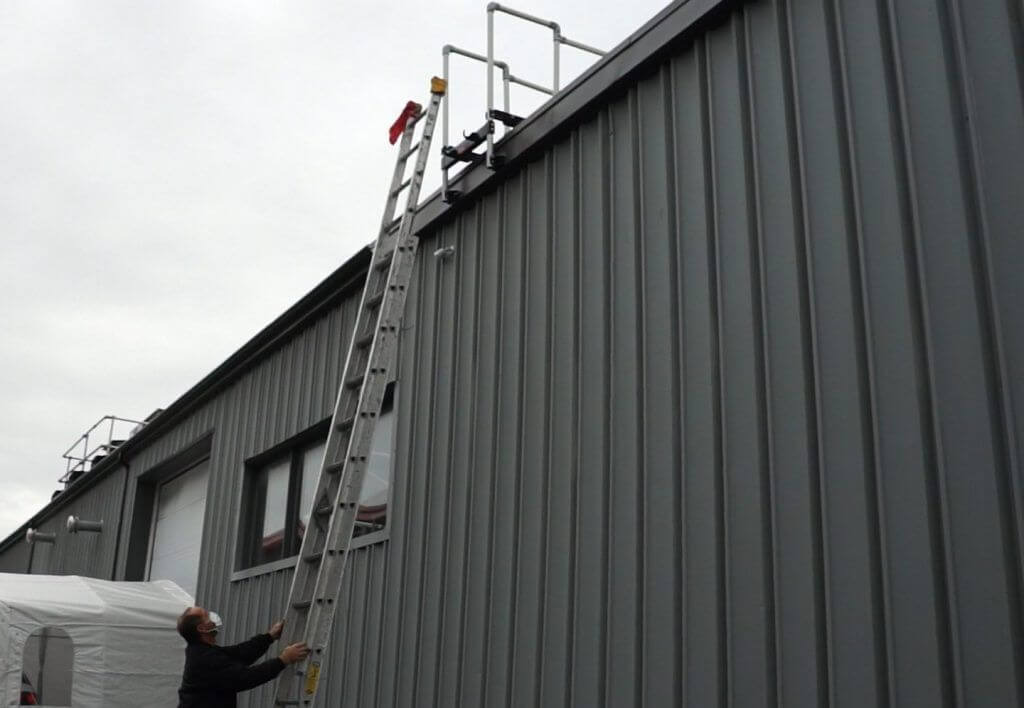
The perimeter may be perfect, but the climb is often improvised. Every year, workers are injured while climbing an improperly secured extension ladder. Yet, regulations govern this access: a portable ladder used as a means of access must be securely fixed in place, extend at least 900 mm above the upper landing, and be certified compliant with the CSA Z11 standard for portable ladders. A rope or bungee cord does not constitute a proper fixation.
The Delta Prevention ladder stabilizer creates safe access to roofs served by an extension ladder. It can be installed in minutes without anchors or drilling, whether or not a parapet is present. Its hooks adapt to round or D-rung ladders up to 2 inches in diameter, preventing the ladder from sliding along the parapet and keeping it completely immobilized. The hoops provide a solid grip when exiting the ladder, and the integrated guardrails guide the worker toward the center of the roof, away from the edge.
The assembly adapts to the configuration. The adjustable clamp and its adjustment screw attach to the parapet, or the clamp can pivot to serve as a support point on roofs without a parapet or with a parapet wider than 11 inches. The installation can be permanent or temporary, making it as much a reusable piece of jobsite equipment as a maintenance solution. On a building with HVAC units, the stabilizer can remain on the roof to make every maintenance visit safer.
Why now, and not in January
The Quebec winter adds four problems at once. Snow hides the roof edge, skylights, and hatches. Ice makes surfaces slippery exactly where people need to walk. Roof snow removal becomes mandatory as soon as the weight threatens the structure, and it is performed under the worst possible conditions. Installing equipment on a snow-covered membrane, finally, is neither simple nor recommended.
The CNESST reminds us that snow removal should first be considered from the ground, then from a lifting device equipped with guardrails, and only as a last resort directly on the roof. When being on the roof is unavoidable, protection must already be in place. A roof secured with guardrails in September is a roof you can work on in February.
FAQ
Are your roofs ready for winter?
A site visit allows us to identify fall hazards that need to be eliminated and to choose the right configuration for each section: perimeter, hatch, skylight, mechanical units, and access points.
Talk to an expert at Prox-Secur Solutions at 438-500-0891 to plan your work before the first snowfall.
Sign up for our newsletter
Do you know our advice even in your daily life?