
Pedestrian safety barrier

Marie-Claude Plante
President of Solutions Prox-Secur
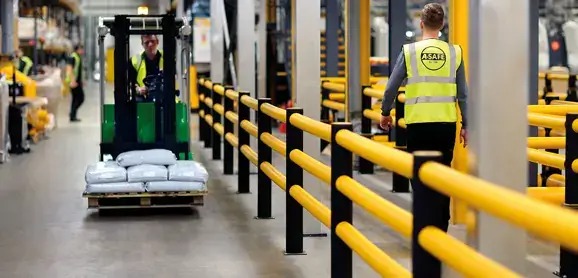
Floor markings won't stop a forklift, and a steel barrier only works once: after an impact, it rips out of the concrete slab and becomes a repair expense. A pedestrian safety barrier is only useful if the model matches the actual vehicles, speeds, and impact angles at your site. Here is how to make that choice, starting with the iFlex 3-rail pedestrian barrier and other A-SAFE barrier models that Prox-Secur installs in Quebec.
5 key points
- A pedestrian barrier serves two functions at once: it visually defines traffic lanes and absorbs impact energy.
- The iFlex 3-rail pedestrian barrier is suitable for facilities where light vehicles operate or where the risk is a low-angle impact, both indoors and outdoors.
- The protection range matters more than the total height: here, it is 450 to 1100 mm, with 100 mm diameter rails.
- Polymer deforms and then returns to its original shape; steel deforms only once and transfers the load to the slab and the fixings.
- A-SAFE barriers are rated by impact level and independently verified by TÜV Nord according to PAS 13, allowing you to compare models rather than guess.
What is a 3-rail barrier used for
The iFlex 3-rail pedestrian barrier is designed to separate and protect pedestrians from moving vehicles and workplace hazards, both indoors and outdoors. It is the right choice where light vehicles operate, or where the realistic risk is a low-angle impact accident rather than a full-speed collision. Flexible, energy-absorbing barriers visually define traffic lanes and physically protect pedestrians and drivers by cushioning and deflecting impact forces.
In terms of features, the model relies on 100 mm diameter rails, an impact zone of 450 to 1100 mm, patented coupling technology, and an electrophoretically coated base.
Other models cover the rest of the situations. The eFlex 3-rail barrier is designed for logistics sites: high-visibility flexible barriers that delineate pedestrian walkways and prevent visitors and staff from wandering out of designated pedestrian zones, both indoors and outdoors. The iFlex Pedestrian Barrier 3 Rail Cold Storage version targets very cold environments like cold storage warehouses, where the risk of collision comes from order pickers. When the challenge is a heavy vehicle hitting a structure, the iFlex Traffic Double barrier takes over, with a double rail for high-impact areas.
Four functions to specify before ordering
The choice becomes simple once you define what each section of the barrier needs to accomplish.
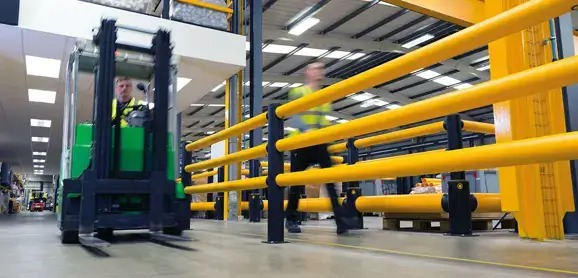
Define walkways. Clearly defined pedestrian walkways help guide people, organize the facility, and improve safety.
Organize facilities. The pedestrian barrier is multidirectional. It adapts to existing layouts, reorganizes pedestrian routes, and increases productivity.
Prevent impacts. The barrier eliminates the underlying danger between pedestrians, moving vehicles, machinery, and hazards. Fewer accidents, minimal downtime.
Separate pedestrians. This is the ultimate goal: distinct pedestrian routes that are physically and visually separated from dangerous machinery, especially forklift traffic.
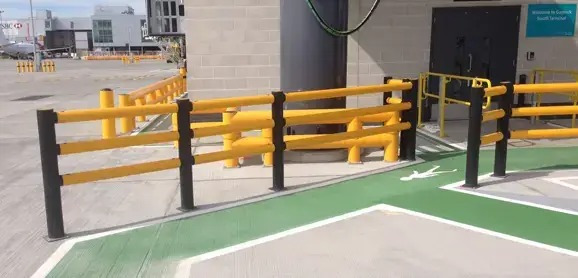
Crossing points are part of the design, not last-minute adjustments. The iFlex short gate creates controlled access because pedestrians must pull the gate instead of walking straight through. A hydraulic closer returns it to the closed position after each use, and stops limit the opening direction to force a full stop. The long gate follows the same principle for wider openings. The iFlex bollards and their reinforced version
complete the system where a physical presence is needed to protect equipment or guide traffic.
The types of safety barriers available, and how to choose them
Fixed pedestrian barriers. The gold standard for the permanent demarcation of pedestrian walkways and the separation of pedestrians from forklifts in warehouses and handling areas where forklift traffic is constant.
Removable barriers. The removable barrier is designed for areas where a barrier must remain in place for pedestrian-forklift separation or equipment protection, but where occasional access is still required. U-shaped floor-anchored mounting plates maintain the integrity of the line while allowing sections to be removed or slid aside, for example, for maintenance.
Traffic barriers and Atlas range. When it comes to protecting buildings, machinery, and equipment, the mFlex Traffic barrier provides visual guidance for forklift operators and physical protection by absorbing high-impact forces. The ultra-durable Atlas range withstands repeated impacts. The Atlas Triangle channels heavy forklifts through doorways and guides vehicles at traffic intersections, both indoors and outdoors.
Sliding and swinging barriers. Designed by Delta Prevention, the sliding barrier and the swinging barrier secure loading zones on roofs or mezzanines and separate two work areas. The sliding model is 100% self-supporting.
Portable outdoor barriers. The system RapidRoll from Ideal Warehouse Innovations is easy to transport, can be installed by a single person, and meets temporary job site needs.
How to decide. Look at the actual flow of people and equipment. A permanent line along a traffic lane calls for a fixed barrier; a line ending at a maintenance door calls for a removable section; a loading zone at height calls for a sliding or swinging gate. The staff working in the area are the best source of information on where people are actually cutting across lanes.
Polymer vs. Steel
This is where the real cost is determined.
Steel barriers date back to the 1930s and were originally designed for road traffic. They are rigid, and an impact permanently deforms them. More importantly, they act as a lever, transmitting force to the anchors that exceeds their pull-out strength. The result: damaged concrete slabs, recurring repair costs, and barriers that remain bent even after a minor impact. Galvanized or painted steel requires maintenance; the paint chips, rust appears, and forklifts that scrape against the steel are also damaged, which is costly when the fleet is leased.
A-SAFE polymer barriers absorb energy along the entire length of the barrier and return to their original shape, protecting the slab, the vehicle, and the barrier itself. The color is molded throughout, so it remains vibrant and highly visible, and the barrier does not rust. A-SAFE invented the first polymer barrier for industry in 2001. The current third generation is based on a patented multi-layer, multi-component formulation designed for the most demanding industrial environments.
This comparison remains the manufacturer's engineering argument. What makes it verifiable is the next section.
Certification: How PAS 13 changes the purchasing process
The PAS 13 is the British Code of Practice for safety barriers used in workplace traffic management. It provides recommendations on impact resistance, dimensions, and barrier positioning, and defines methods for testing impact resistance. It applies wherever a vehicle or work machine risks colliding with a pedestrian. It is the international benchmark for testing and installing safety barriers.
TÜV Nord, an independent testing and certification body, tests industrial barriers according to PAS 13. This independent verification makes all the difference when purchasing, because A-SAFE products are rated by standard impact levels. You can therefore compare models and choose based on the actual forklifts, weights, and speeds present on your site. Steel guards, on the other hand, are rarely tested and have no impact resistance scale. The only rule available becomes "bigger forklift, bigger barrier," which is not a specification.
For the 3-rail iFlex, the pendulum test video shows the barrier's behavior during a 90° dynamic impact, with independent verification by TÜV Nord.
Compliance in Quebec
Two local benchmarks govern this issue. Forklift safety is based on Section 256 of the Regulation respecting occupational health and safety, and the CNESST guide on forklifts specifies that pedestrian and forklift traffic lanes must be clearly delineated. A barrier is what prevents this requirement from being reduced to floor tape that wears off in three months.
The scale of the risk is well-documented. According to CNESST investigation reports from 2013 to 2023, collisions between mobile machinery and pedestrian workers have caused an average of three deaths per year in Quebec. The majority of these accidents occurred outdoors and on construction sites, but the mechanism remains the same as in a warehouse: a driver, a pedestrian, and no physical separation.
Three questions to help you decide
- What is hitting what? Light vehicles and low-angle impacts: 3-rail pedestrian barrier. Heavy vehicles against a structure: traffic barrier or bollards.
- What is the environment? Standard indoor and outdoor, or a cold storage warehouse where the polymer must withstand extreme cold?
- Where do people cross? Every crossing point requires a gate that forces a stop, not just an opening left in the barrier line.
These three answers are enough to determine the selection: the type of barrier, the floor anchoring points, the removable sections to include, and the residual risks that will be addressed through floor markings, signage, or training rather than a barrier. A formal quote is then built based on the floor plan, section by section.
FAQ
Next step
Are you torn between a 3-rail pedestrian barrier and a traffic barrier? Speak to a Prox-Secur expert : the impact rating will be aligned with your specific forklifts and actual operating speeds.
Sign up for our newsletter
Do you know our advice even in your daily life?


