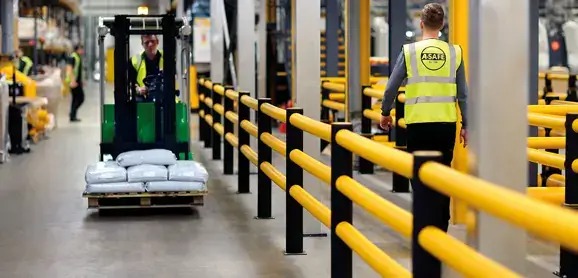
A-SAFE Heavy Duty iFlex barrier and mFlex Traffic barrier: two solutions to secure your warehouse

Marie-Claude Plante
Rédacteur spécialisé dans la création de contenus clairs
In a warehouse, safety isn't just about the floor. A stacked pallet that tips over, a load sliding off a rack, or a forklift clipping a stack can endanger personnel walking nearby. And lower down, walls and equipment take the brunt of forklift collisions. Solutions Prox-Secur offers two A-SAFE barriers for these two risks: the Heavy Duty anti-fall barrier, which retains goods stored at height and protects pedestrians, and the mFlex Traffic barrier, which protects buildings from forklift impacts. Here is how each protection works, where to install them, and how to combine them.
The 5 key points
- The Heavy Duty anti-fall barrier protects pedestrians against falling stacked pallets and forklift impacts.
- A ForkGuard anti-fork protection is integrated into the base of the Heavy Duty barrier.
- The mFlex Traffic barrier protects buildings and machinery from forklift collisions, both indoors and outdoors.
- A-SAFE safety barriers are modular, tested according to PAS 13, and independently verified by TÜV Nord.
- In Quebec, the CNESST reminds us that pedestrian walkways must be protected from the risk of falling objects or materials.
Why falling loads are a major risk in warehouses
High-density storage increases a building's capacity, but it also increases risks. Stacked pallets, products piled on the floor, and loads placed in racking can fall into an aisle during an impact, a handling error, or improper stacking. The danger directly affects employees, forklift operators, and merchandise, especially near loading docks where safety is put to the test with every delivery.
The CNESST cites the total or partial collapse of racking and falling loads among the risks of warehousing. It also reminds us that pedestrian walkways must be protected from the risk of falling objects or materials (CNESST document on racking, forklifts, and warehouses). The regulatory framework for occupational health and safety can be found in the Regulation respecting occupational health and safety.
An anti-fall protection therefore meets two safety needs at once: retaining products stored in racking and physically separating pedestrians from handling equipment.
What the A-SAFE Heavy Duty anti-fall barrier is
The Heavy Duty version is the reinforced protection in the A-SAFE anti-fall range. It is designed to guide pedestrians and protect them from forklifts and the danger of falling stacked pallets. Robust, it offers enhanced safety for racking.
Flexible protection rather than steel protection
A-SAFE safety barriers are made of polymer. Unlike steel protection, a flexible barrier absorbs the energy of an impact and then returns to its original shape. The manufacturer notes that these barriers do not rust, corrode, or require repainting. Steel protection, on the other hand, deforms after a significant impact.
A fully modular system
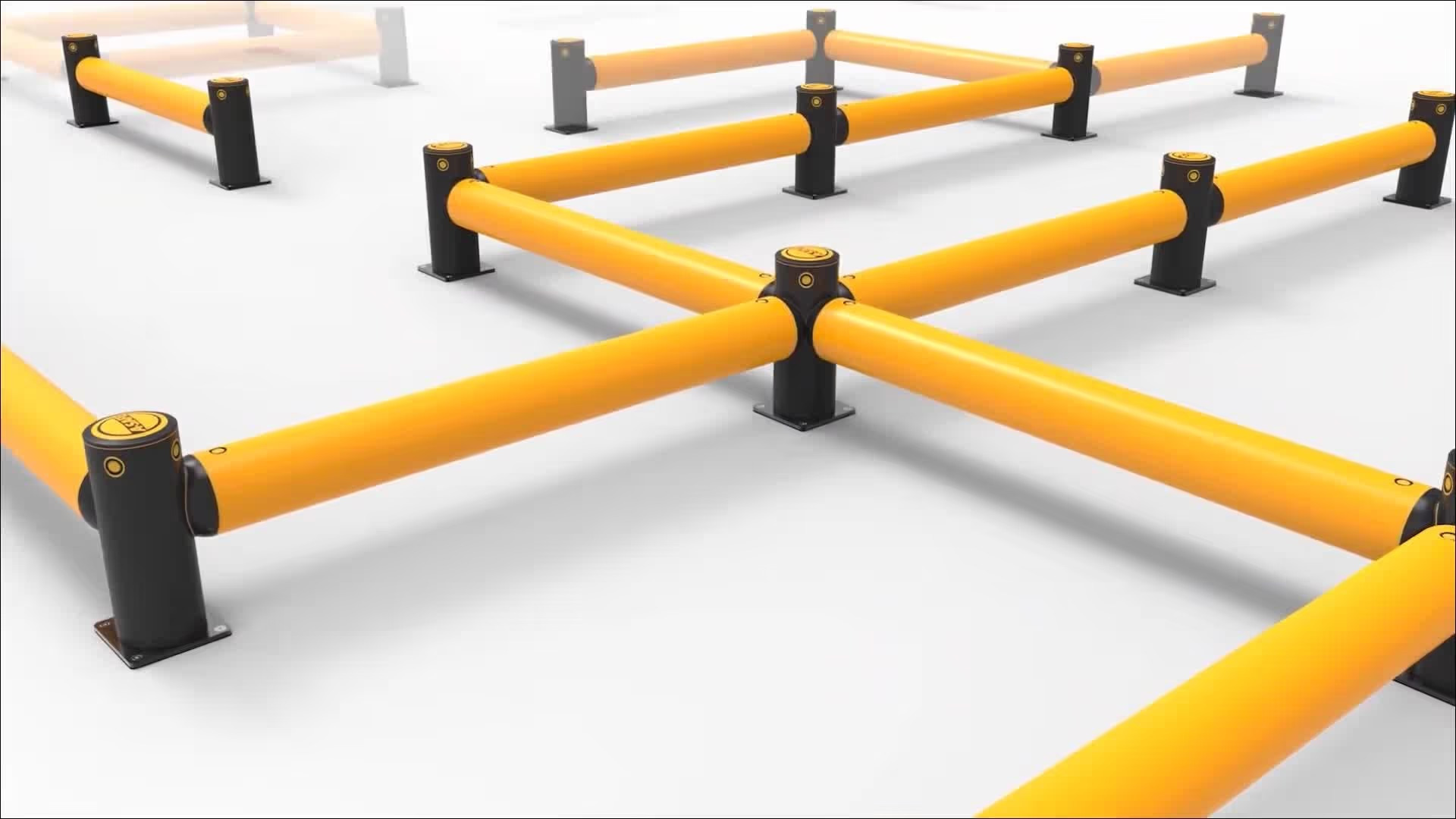
The system is entirely modular. You can add as many rail modules as needed to the base unit to achieve the required level of protection. According to the A-SAFE spec sheet, the Heavy Duty barrier ranges from 141 ¾ in to 204.7 in, or approximately 3.6 m to 5.2 m. The multi-directional posts follow your racking configuration, and the protection is available in several lengths, in yellow or black.
Integrated base-level fork protection
ForkGuard protection is included at the base. It prevents the forks of a forklift or pallet truck from passing under the barrier and striking products or the feet of a pallet rack. It also serves as a stop for pallets placed on the floor.
Impact resistance: what the tests say
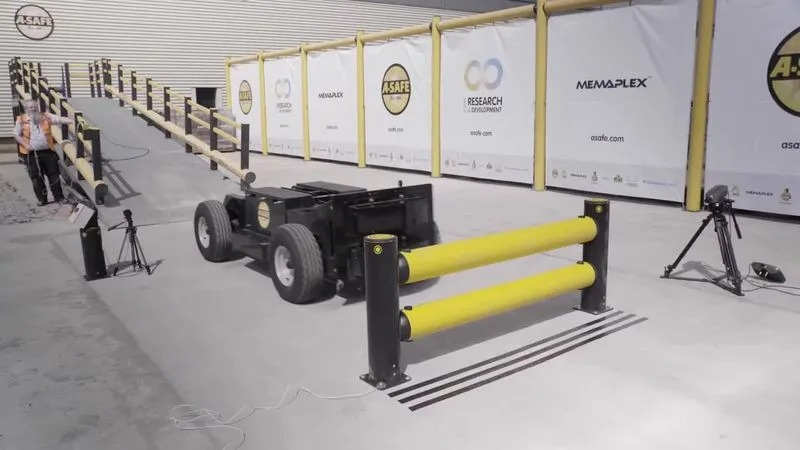
A-SAFE publishes an impact rating for this barrier: a vehicle equivalent to 6.3 US tons at 6 mph, representing an energy of 20,500 joules, at a 90° angle. It is suitable for trucks with an impact height between 8 in and 21 ¼ in.
These tests follow PAS 13, the British code of practice for safety barriers used in workplace traffic management. It also provides recommendations on impact resistance testing methods. TÜV Nord, an independent testing and certification body, verifies the results. Prox-Secur can provide you with the reports and certificates upon request.
Where to install fall protection in your warehouse
The Heavy Duty barrier can be placed anywhere high-stored loads are near pedestrian or vehicle traffic:
- along pedestrian walkways bordering pallet racks and pallet stacks;
- at the end of aisles, where a load could slide into a walkway;
- around stacking areas;
- near loading docks and delivery areas, where forklifts are constantly moving;
- around storage spaces adjacent to workstations.
Fall protection, rack protection, and bollards: the difference
Rack protection (bollards, protection posts, rack guards) protects the pallet rack structure against forklift impacts. A flexible bollard placed at the feet of a rack absorbs the shock instead of the upright, and an end-of-aisle bollard protects the rack frame. Pedestrian barriers, on the other hand, delineate aisles and separate pedestrians from vehicles. Fall protection does both and adds a function: it retains stacked pallets so they do not fall into an aisle.
In most warehouses, these protections complement each other. Well-protected racking often combines bollards, protection posts, rack guards, and fall protection, with rails at the appropriate height.
Near the loading dock
The loading dock is a hub of activity: delivery trucks, loading, and pallets awaiting shipment. Between deliveries, pallets are often temporarily stacked there, next to pedestrian traffic. Fall protection in this area secures personnel without blocking loading operations. It is also a good place to combine fall protection with a flexible bollard at the corner of the dock.
A-SAFE's mFlex Traffic barrier: protecting buildings and machinery
Not all collisions come from above. In traffic aisles, a truck clipping a wall, column, or door causes property damage and production downtime. The mFlex Traffic is designed to protect buildings and machinery from damage caused by forklift collisions, both indoors and outdoors.
Visual guidance and physical protection
Flexible and robust, the mFlex Traffic serves a dual purpose. It provides visual guidance for forklift operators, clearly marking the boundary not to be crossed. It also physically protects essential assets by absorbing and deflecting high-impact forces. The result: fewer incidents and less downtime. It is ideal for areas with heavy forklift traffic.
Technical specifications
According to the Prox-Secur data sheet:
- 190 mm diameter rail;
- impact zone from 205 to 395 mm;
- patented coupling system;
- electrophoresis-protected bases, with several base options.
Where to install the mFlex Traffic barrier
- along walls and partitions bordering a traffic aisle;
- around production machinery;
- in front of doors and columns;
- outdoors, around loading and delivery areas, and along delivery routes.
Dock and delivery area safety
At loading docks, safety depends on the interaction between delivery trucks, material handling equipment, and employees. Vehicles reverse, delivery pallets accumulate, and infrastructure (doors, levelers, columns) is subjected to repeated impacts. The mFlex Traffic protects this infrastructure and dock equipment, while the Heavy Duty barrier secures stacked delivery pallets waiting to be moved. Add protective hoops to exposed corners and rack guards in front of racking uprights to complete your logistics safety setup.
Heavy Duty or mFlex Traffic: which one to choose?
The two types of protection serve different purposes. Heavy Duty protects pedestrians against falling stacked pallets and forklift collisions. mFlex Traffic protects buildings and equipment against forklift impacts. In the same warehouse, they are often combined: Heavy Duty along pallet racking and stacking areas, and mFlex Traffic along walls. An assessment of your facility will help you place the right protection in the right location.
The benefits of A-SAFE barriers for your warehouse
- Protecting employees and workplace safety : physical and visual separation creates pedestrian routes protected from forklifts.
- Organize logistics : clearly defined aisles make traffic and logistics flow more smoothly.
- Prevent accidents : fewer accidents and collisions between pedestrians, forklifts, and stacked pallets, resulting in fewer injuries and less property damage.
- Protect pallet racking and buildings : the anti-fork base protects the racking, while mFlex Traffic protects walls and columns. It provides an extra layer of protection for pallet rack safety.
- Reduce downtime and safety costs : flexible protection that returns to its original shape limits the need for repairs after an impact.
Properly install and maintain your barriers
Installation is carried out according to the A-SAFE installation guide, available with the technical data sheet on each product page. The choice of height, placement, and floor mounting depends on your products, equipment, and aisle traffic. That is why the Prox-Secur safety team begins with a safety assessment of your premises and pallet racking.
After a significant impact, inspect the posts, base plates, and fasteners. Damaged base plates reduce the strength of the entire protection system. Damaged protection no longer ensures the safety of your personnel as intended. Periodic inspection of pallet racking and its protective equipment is also among the best practices recommended by the CNESST.
What is the price of these barriers?
The price depends on the length to be protected, the height of the stacked pallets for the Heavy Duty model, the type of base for the mFlex Traffic, the number of posts, rails, and base plates, and the site layout. The price also accounts for accessories, such as a hoop or a protective post. To provide an accurate price, Prox-Secur prepares a quote after assessing your safety needs and delivery zones.
Complementary solutions for warehouse safety
Fall protection is part of a broader approach to overall warehouse safety. Prox-Secur also offers:
- the Laserglow line projectors, a floor marking solution that requires no paint or tape;
- the collision avoidance systems to reduce collisions between pedestrians and forklifts.
To better understand this risk, also read our article on forklift-pedestrian collisions.
FAQ
Speak with a Prox-Secur expert
Pallets stacked near aisles or walls exposed to forklifts? Speak with a Prox-Secur expert at 514 333-0077 to assess the safety of your facility.
Sign up for our newsletter
Do you know our advice even in your daily life?